My watch was stolen. What should I do?
If your luxury watch has been stolen, report the theft to the police and obtain a crime reference number. Make sure the watch's serial number is included in the report, gather your proof of ownership, and notify the manufacturer and your insurer. Register the watch on reputable stolen-watch databases. If you find it for sale, do not contact the seller yourself.
Watch Recovery International specialises in the recovery of stolen luxury watches and the resolution of ownership disputes. Led by attorney Christopher A. Marinello, Esq., we work with law enforcement, insurers, manufacturers, auction houses and watch dealers to help rightful owners recover their property.
The first steps you take after a theft can make a difference, whether the watch is located tomorrow or several years from now.
Stolen watch? Start here.
Report the theft to the police. Obtain a police report and crime reference number, and make sure the watch's serial number is recorded.
Gather proof of ownership. Collect receipts, certificates, warranty cards, service records and photographs.
Notify the manufacturer. Ask how to register the theft and whether the brand can flag the watch if it is brought in for service. We can do it for you.
Contact your insurer. If the watch is insured, notify your insurer promptly and follow the claims procedure.
Register the stolen watch. Use reputable stolen-watch databases to increase the chances of the watch being identified.
Do not approach a seller yourself. If the watch appears online or at auction, preserve the evidence and seek advice before making contact. We can help you with that.
These steps help establish ownership, preserve important evidence and improve the chances of identifying the watch if it reappears.
1. How do I report a stolen watch to the police?
File a police report as soon as possible and obtain a crime reference number.
Ask for a copy of the report and make sure the stolen watch's serial number is included. If you do not have the serial number when reporting the theft, take the investigating officer's contact details and ask for the report to be updated when you find it.
The serial number is particularly important.
When a stolen watch resurfaces, the person holding it may question whether it was actually stolen or legitimately sold by its previous owner. A police report identifying the watch by its serial number is an important part of establishing the circumstances of the theft.
It is also one of the documents insurers commonly require when processing a claim.
"A lot of people think that after they report their watch as stolen, the police will return your stolen watch to you within a matter of weeks. Unfortunately, that is not going to happen in most cases. They'll simply give you a police report number or a crime reference number to give to your insurance company, and that'll be the end of that."
— Christopher A. Marinello, Esq.
Reporting the theft remains essential, even if the police are unable to pursue an immediate investigation.
If the watch is found in another country years later, the original police report can become an important part of the recovery process.
2. What proof of ownership should I gather?
Gather as much documentation as possible to identify the watch and establish your ownership.
Useful documents include:
Original purchase receipt or invoice
Warranty card or certificate
Original box and accompanying papers
Manufacturer or authorised service records
Insurance schedule or valuation
Photographs showing the watch, including any distinctive marks or damage
If you do not know the serial number, it may appear on the purchase invoice, warranty documentation or service records.
Keep digital copies of everything in one place. You may need to provide these documents to the police, manufacturer, insurer or recovery representative.
Do not confront anyone you suspect of being involved.
3. Should I notify the manufacturer if my watch is stolen?
Yes. If your Rolex, Patek Philippe, Richard Mille, Audemars Piguet or another luxury watch has been stolen, contact the manufacturer and ask about its stolen-watch reporting procedures.
Provide the serial number, police report and any supporting ownership documentation requested by the brand.
Where the manufacturer maintains a stolen-watch register or reporting process, ask whether the watch can be flagged if it later enters its authorised service network.
This is particularly important because luxury watches frequently return to manufacturers and authorised service centres for maintenance or repairs.
A stolen watch may pass through several owners before eventually being submitted for servicing.
"The strongest of those databases is maintained by the manufacturers themselves. Rolex, Patek Philippe, Richard Mille, AP, they all maintain databases of stolen watches and are supposed to notify you if your stolen watch is ever brought into one of their service centers anywhere in the world."
— Christopher A. Marinello, Esq.
Each manufacturer has its own procedures. Registration, monitoring and notification are not necessarily available in the same way across all brands or jurisdictions.
When reporting the theft, ask the manufacturer to explain what action it can take if the watch is identified.
Provide reliable contact details and retain copies of all correspondence. They will usually ask you for prove of ownership, invoice, insurance papers or service documents.
Watch Recovery International can assist with manufacturer notifications and, where appropriate, act on behalf of a client.
4. Should I register my stolen watch on other databases?
Yes. In addition to contacting the manufacturer, we recommend registering your stolen watch with reputable databases used by dealers, collectors, auction houses and other participants in the watch market.
One example is Enquirus, a platform established by Richemont to help fight watch and jewellery theft.
Registration can help identify a stolen watch when someone checks its provenance before purchasing, selling or handling it.
However, there is an important distinction between locating a stolen watch and recovering it.
A stolen-watch register is a discovery tool. It is not, by itself, a recovery process.
A database may identify a possible match, but recovering the watch can still require legal intervention, negotiations with the current possessor, cooperation with the police or an agreement between parties.
"We use it ourselves. However, where it falls short is the recovery process. If a stolen watch is located via the Enquirus system, there is really no system in place to assist theft victims in recovering their stolen watches."
— Christopher A. Marinello, Esq.
Some registration services also offer recovery assistance. Before agreeing to any additional services or fees, ask who the company represents, how it is paid and whether it has commercial relationships with dealers or auction houses involved in the matter.
In some cases, those relationships create a conflict of interest.
If a database informs you that your stolen watch has been identified, consider obtaining independent legal or recovery advice before contacting the person holding it.
5. What should I tell my insurer if my watch was stolen?
If your watch was insured against theft, notify your insurance company promptly and open a claim.
Provide the police report, crime reference number, proof of ownership and any other documentation requested under your policy.
We can help your insurer recover the watch.
What happens if my stolen watch is recovered after an insurance payout?
When an insurer pays a theft claim, rights to the recovered watch may pass to the insurer, depending on the policy.
In some cases, the original owner may be able to buy the watch back from the insurer by returning the insurance payout.
This should not be assumed. Check the policy wording and discuss the possibility with your insurer or broker.
Where recovery work is required, an insurer may also agree to cover the associated costs.
Watch Recovery International works with fine art and specie insurers, loss adjusters and legal representatives to assist with the recovery of stolen timepieces.
Even if your watch was not insured, it is still possible to pursue recovery. The absence of insurance does not prevent you from reporting the theft, registering the watch or seeking specialist assistance.
6. I found my stolen watch online. Should I contact the seller?
No. Do not contact the seller yourself before obtaining advice from the police or an appropriate recovery professional.
If you believe you have found your stolen watch on a marketplace such as Chrono24, Ebay, Catawiki…, through a watch dealer or in an auction catalogue, avoid sending messages, posting comments or publicly accusing the seller of possessing stolen property.
You should also avoid offering to buy the watch back.
An unexpected approach may alert the person holding the watch and cause it to disappear from the market.
In some cases, a seller or auction house may return the watch to the person they bought it from, and the watch may disappear again. Other dealers and auction houses may cooperate with the police or agree to hold the watch while competing ownership claims are resolved.
The correct approach depends on the circumstances. What matters is that the initial contact is carefully planned. That is our job.
What should I do if I find my stolen watch for sale?
Preserve the available evidence immediately:
Save the complete URL of the listing.
Record the marketplace, dealer or auction house involved.
Call us.
If you are uncertain, preserve the information and seek advice before taking further action.
If your stolen watch has already been located, you can contact Watch Recovery International for a confidential assessment of the available evidence and recovery options.
7. The manufacturer has found my stolen watch. Will they return it?
Not necessarily.
When a manufacturer identifies a watch reported stolen, it may hold the timepiece while the relevant authorities or parties establish who has the legal right to possess it.
The procedures depend on the manufacturer, the circumstances and the laws of the country where the watch is located.
The person who submitted it for servicing may have acquired the watch without knowing it had been stolen.
This creates a dispute involving the original owner, the current possessor and potentially an insurer that has already paid a theft claim.
The manufacturer may therefore be unable to return the watch simply because someone presents an earlier police report.
In some situations, law enforcement must intervene. In others, a civil agreement or legal proceedings may be needed.
We know how to recover watches in these situations. Contact us.
Why can recovering a watch from another country be difficult?
International recovery cases can involve different police forces, legal systems and rules governing ownership.
For example, a watch stolen in the United Kingdom may later be submitted for servicing in Switzerland.
Even when a manufacturer identifies the watch, obtaining the necessary cooperation or legal authority to recover it may take considerable time.
Watch Recovery International has dealt with cases involving watches held in Geneva where international police procedures caused substantial delays.
Where a watch has been identified, it is important to preserve the relevant documentation and act quickly.
8. How can a stolen watch recovery specialist help?
Reporting a stolen watch and registering its serial number are essential first steps. However, neither guarantees that the watch will be recovered.
A stolen watch may remain missing for years, pass through multiple owners or resurface in a different country.
Even when the watch is located, recovering it can involve difficult legal questions.
Was the current possessor aware that the watch was stolen? Where was it purchased? What due diligence was performed? Who has the legal right to claim it?
These questions can affect the recovery strategy.
Watch Recovery International specialises in resolving these situations.
Our work includes liaising with law enforcement, insurers, lawyers, manufacturers, dealers, auction houses and individuals who may possess stolen watches.
Depending on the circumstances, we may seek an amicable resolution between the parties, coordinate with legal representatives or assist with requests for law enforcement intervention.
Our recovery work is intended to complement police investigations, not replace them.
WRI does not pay ransoms or make payments to individuals connected with the original theft.
Where appropriate, a reward for information may be considered at the request of the owner or insurer, subject to applicable law.
Clients can contact WRI after filing a police report or immediately if a stolen watch has already been identified.
Recovery fees and arrangements depend on the case.
Where a watch was insured, recovery costs may be covered by the insurer, subject to approval.
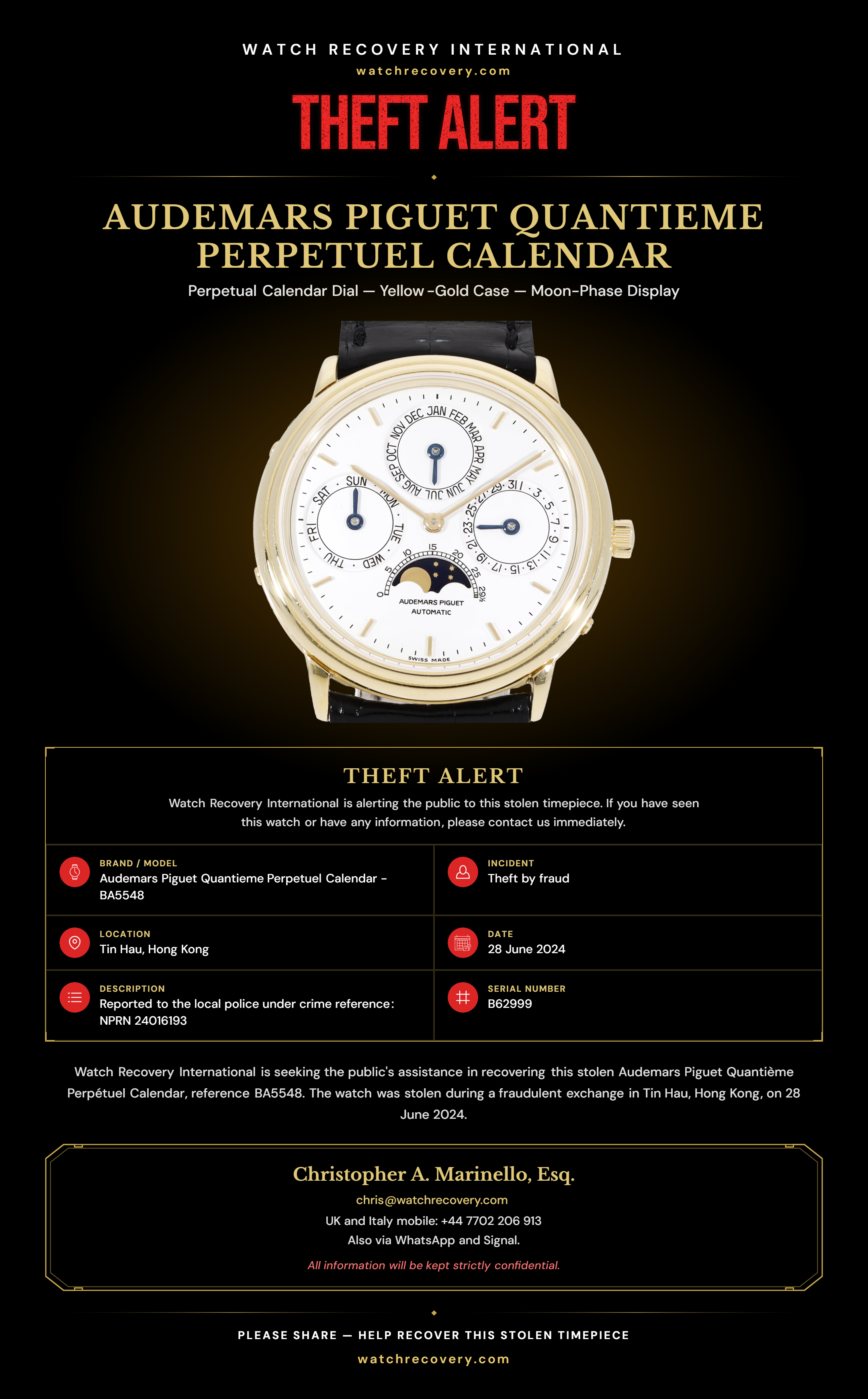
WRI also publishes stolen-watch alerts where publicising the theft may assist in identifying the watch.
9. Can a stolen luxury watch be recovered years after it was stolen?
Yes. A stolen luxury watch can resurface many years after the original theft.
Fine timepieces often remain in circulation for decades. They may be resold privately, passed between collectors, offered at auction or sent to a manufacturer for servicing.
This is why preserving the original police report, serial number and proof of ownership is so important.
Those records may become relevant long after the initial investigation has ended.
The possibility of recovery depends on several factors, including whether the watch can be positively identified, where it is located, the available evidence and the laws governing ownership in the relevant jurisdiction.
A successful identification does not automatically guarantee recovery. However, the passage of time alone does not necessarily mean that a watch is lost forever.
Watch Recovery International has experience resolving ownership disputes involving timepieces stolen years before they were located.
You can explore our website to learn more about our work.
Frequently asked questions
What should I do first if my Rolex or another luxury watch is stolen?
Report the theft to the police and obtain a crime reference number. Make sure the serial number appears on the report. Gather proof of ownership, notify the manufacturer and your insurer if applicable, and register the watch with reputable stolen-watch databases.
Do I need the serial number on the police report?
Yes, whenever possible. The serial number helps identify the specific watch if it later appears for sale or servicing. If you did not have it when filing the report, ask the police whether it can be added later.
Can I register my stolen Rolex with the manufacturer?
Contact Rolex or the relevant authorised channel to ask about its stolen-watch reporting procedures. Have your police report, serial number and proof of ownership available. Procedures may vary between manufacturers.
We can handle this for you. We work directly with watch manufacturers.
I found my stolen watch on Chrono24 or at auction. Can I contact the seller?
We recommend that you do not approach the seller yourself. Save the listing, photographs, seller details and any visible serial number. Contact Watch Recovery before making an approach.
Will the manufacturer return my watch if it is found during servicing?
Not automatically. A manufacturer may need to involve law enforcement or wait for an ownership dispute to be resolved. The process depends on the manufacturer and applicable law.
Will the police recover my stolen watch?
Police involvement is essential, but recovery cannot be guaranteed. Cross-border cases can be particularly complex. Specialist recovery work may complement law enforcement by helping locate the watch, establish the ownership claim and coordinate with the relevant parties.
What happens if my stolen watch is recovered after an insurance payout?
Depending on the policy and applicable law, the insurer may acquire rights to the recovered watch after settling the claim. You may be able to reacquire it under an agreement with the insurer. Discuss this with your insurer or broker.
Can a stolen watch be recovered without its original box or papers?
Potentially, yes. A police report, serial number, purchase records, service documents, insurance records or other evidence may help establish identity and ownership. The strength of the available evidence will affect the case.
Can a stolen watch be recovered after several years?
Yes. Stolen watches can resurface years later through dealers, auction houses or authorised service centres. Whether recovery is possible depends on identification, evidence and the applicable legal circumstances.
What is the difference between registering a stolen watch and hiring a recovery specialist?
Registration helps identify a watch when it reappears. A recovery specialist like Watch Recovery International, works on the steps needed to secure its return, which may involve law enforcement, legal representatives, insurers, dealers or the current possessor. Registration and recovery are complementary but distinct processes.
Contact Watch Recovery International
Watch Recovery International is a wholly owned subsidiary of Art Recovery International, LLC, led by Christopher A. Marinello, Esq.
If your luxury watch has been stolen, or if you believe you have located it, you can contact us for a confidential consultation.
Email: chris@watchrecovery.com
Mobile: +44 (0) 7702 206 913
Also available on WhatsApp and Signal.
All enquiries are handled discreetly. Non-disclosure arrangements may be available where appropriate.
Watch Recovery International | Stolen-watch alerts | Contact us